
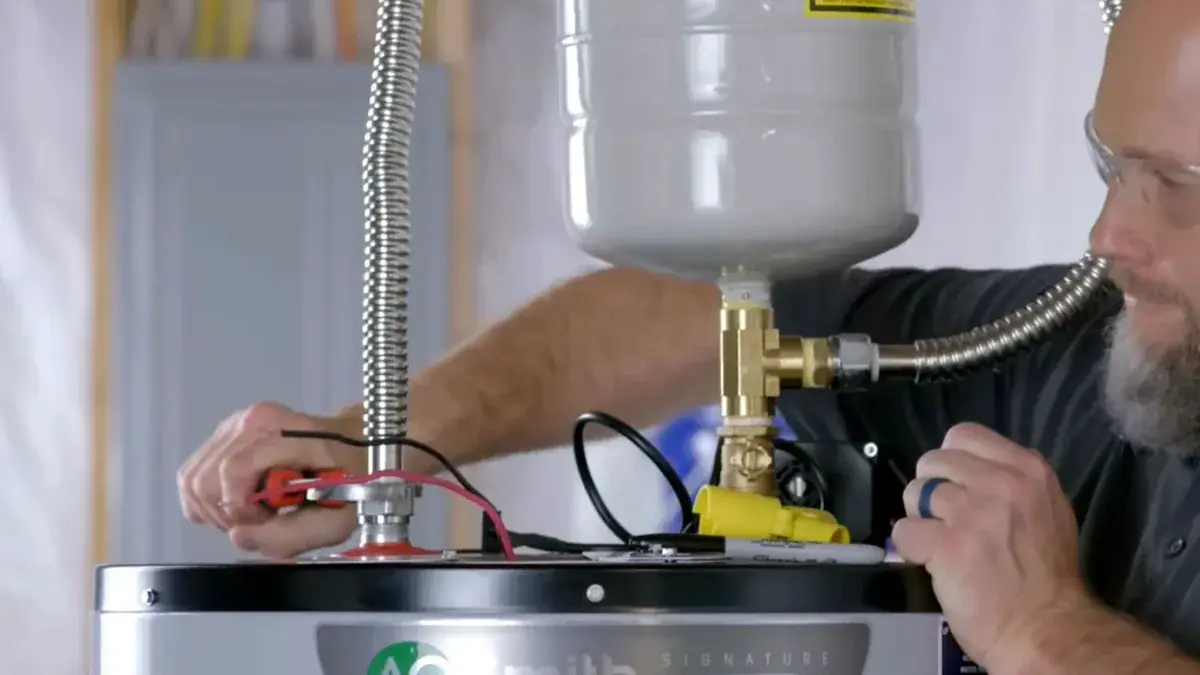
The short answer on lifespan
The Department of Energy's consumer guidance says most storage water heaters last 10 to 15 years, while tankless models can last more than 20. Those ranges are averages. A tank in a conditioned closet with a well-kept anode rod can outlast a tank in a hot attic. A unit in a house with heavy mineral buildup can fail early.
Treat the range as a planning window, not a deadline. At 10 years, start watching. At 12, start pricing a replacement. At 15, expect the next serious repair to be the last one.
How to find out how old your tank is
The rating plate on the side of the tank lists the model and serial number. Most manufacturers encode the manufacture date in the serial number, usually as a letter for the month and two digits for the year. The code layout varies by brand, so a quick search of the brand's own documentation tells you how to read it.
If the plate is unreadable, ask the plumber to check on a visit. We read tank dates routinely and can tell you how many years you likely have left, given what we see in the tank, the fittings, and the base.
Warning signs and what they usually mean
Some symptoms call for a repair. Others say the tank is finished.
| Sign. | What it usually means. | Typical next step. |
|---|---|---|
| Rusty or brown hot water, cold water clear. | Tank interior corroding. | Plan to replace. |
| Popping or rumbling on heat-up. | Sediment baked on the bottom. | Flush, and if it recurs, plan to replace. |
| Water pooled at the base. | Leak at a fitting or through the tank. | Find the source. The tank body is a replacement, a fitting is a repair. |
| Lukewarm water, bills rising. | Failed element, thermostat, or a heavy scale layer. | Test the parts before deciding. |
| Tank over 12 years with repeated repairs. | Wear throughout. | Replace on your schedule, not in an emergency. |
Why planned beats emergency
A tank rarely fails politely. It leaks at night or gives out the morning guests arrive. A planned replacement means you pick the model, compare quotes, and schedule the work. An emergency one means you take what is in stock and pay for the haste.
If your tank is past 10 years and in a spot where a leak would damage finished rooms, such as a closet above living space, ask for a drain pan with a pipe to a safe discharge point at the next visit. A pan costs little and can turn a flood into a puddle.
Extending the life of the tank you have
Set the thermostat at 120 degrees, which the Department of Energy calls safe for most people. A lower setting means less stress on the tank and less scale. Check the temperature and pressure relief valve once a year by lifting the lever briefly and making sure water runs out and stops when you let go.
If you know your water leaves deposits on fixtures, consider an annual flush to clear sediment from the bottom of the tank. The anode rod is the sacrificial part that protects the steel. When it is eaten away, the tank starts to corrode. Checking it every few years can add useful life.
Gas, electric, and what the choice does to lifespan
Gas and electric tanks both fall in the same general lifespan range. The failure modes differ. An electric tank's heating elements sit in the water and wear out or scale over, and they can be replaced without replacing the tank. A gas tank's burner, thermocouple, and gas valve wear out separately, and the flue gives a second place to rust.
That difference changes the repair math. An electric tank with a failed element is often a good repair even at an advanced age, as long as the tank itself is sound. A gas tank with a failed gas control valve on a 12 year old unit is usually a replacement, because the part costs a large share of a new tank.
Carrollton, GA note: permits and where your water comes from
The City of Carrollton states on its licenses and permits page that it issues building, electrical, HVAC, plumbing, gas, and pool permits, and that permits are picked up in person by the state card holder. Whether a water heater swap at your address needs one depends on whether the home is inside the city limits, so ask the building office before work starts.
The city's water comes from the Little Tallapoosa River and three reservoirs, and its water quality report did not list a hardness figure. We do not guess at one. If you want to know whether scale is shortening your heater's life, ask the utility or test your tap.
If your tank is near the end
When a tank is at the point of failure, our water heater replacement crews size the new unit and haul the old one away. Our water heater repair visits tell you honestly when a repair is still worth it. We cover Carrollton, Bowdon, and the other towns on the service areas page. Call (770) 214-4545 to talk it through.
Questions readers ask
The City of Carrollton issues plumbing and gas permits, and its page says the state card holder picks them up in person. Whether yours is required depends on the jurisdiction your home sits in, so ask the building office. A licensed plumber will tell you what applies.
Not necessarily. A tank that works, shows no rust, and has no leaks can run longer. But start planning, because failures often come without much warning.
The Department of Energy says they can last more than 20 years, with maintenance. Descaling matters, especially if your water leaves deposits. See our tankless water heater page.
If the tank is sound and the rod is spent, a new rod can extend the life. If the tank has already rusted through, it cannot.
Still have a question? Call and ask. Call (770) 214-4545