
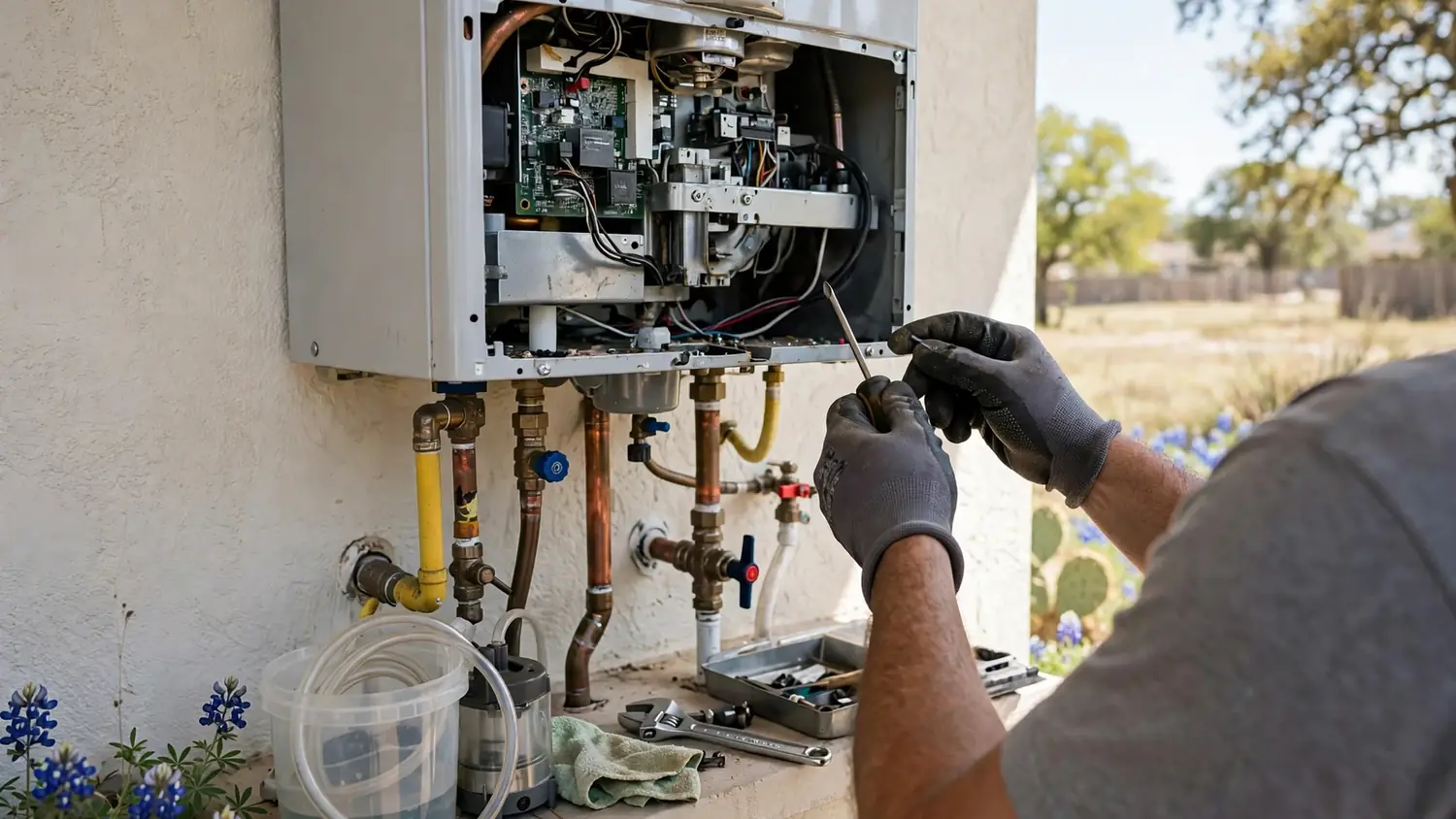
Why a tankless heater needs flushing
A tankless heater warms water in a heat exchanger that holds a thin film of water at high temperature. Minerals in the water come out of solution on hot metal and build up as scale. The scale insulates the exchanger, so the unit works harder, runs hotter, and eventually throws an error code or gives lukewarm water.
A flush circulates a mild acid solution through the exchanger to dissolve that scale. Done on a schedule that suits your water, it can restore flow and protect the exchanger. The Department of Energy says tankless heaters can last more than 20 years, and that figure assumes the unit is looked after.
What a flushing kit includes
Kits are sold under many names, but they share the same parts.
- A small submersible circulation pump, usually rated for acidic solution.
- Two hoses with fittings that attach to the service ports on the isolation valves.
- A five gallon bucket to hold the solution.
- Descaling solution, usually food-grade white vinegar or a citric-based product the maker approves.
- A clean inlet screen, since debris can collect there.
How the flush works
Follow your unit's manual first. The sequence below is the common pattern.
Power down and isolate.
Turn off the power or gas to the unit and close the hot and cold isolation valves.
Connect the hoses.
Attach one hose from the pump to the cold side port and another from the hot side port back to the bucket.
Circulate the solution.
Pour the solution into the bucket and run the pump for the time the manufacturer specifies, often about an hour.
Rinse and restart.
Drain the solution, flush with clean water, clean the inlet screen, reopen the valves, and restore power.
Do it yourself or call a plumber
The job is manageable, but some situations call for a pro.
| Situation. | DIY reasonable? | Why. |
|---|---|---|
| Isolation valves already installed, unit under warranty. | Yes, if the manual allows it. | Follow the maker's steps. |
| No isolation valves. | No. | A plumber needs to add them first, see tankless service. |
| Error codes for ignition or exhaust. | No. | Gas and venting problems are safety issues. |
| Heavy scale and low flow. | Maybe. | A professional flush with the right pump gets more of it. |
Mistakes that damage the unit
Using the wrong solution is the common one. Some acids harm seals and metals in certain units, and the manual lists what is approved. Running the flush too long can also be harsh. Forgetting to reopen the valves leaves the unit starved of water, and firing a tankless heater with no water flow can damage it.
Lose track of the gas or power setting and you can fire the heater during the flush. Always shut off fuel and power first. If you are not sure at any step, stop and call us.
Signs scale is already a problem
Scale does not announce itself. It shows up as a drop in hot water flow, a longer wait for warm water, a temperature that swings, or an error code about overheating or flow. Some units log a code before any symptom appears.
If your heater is more than a couple of years old and has never been flushed, a first flush often produces cloudy water and flakes in the bucket. That tells you the unit needed it. If the water comes out clean, you can stretch the interval. Keep notes on the date so you do not have to guess next time.
Choosing a pump and solution
The pump matters less than people expect. Any small submersible utility pump with hose fittings that match your isolation valve ports will do the job, provided the maker says it handles the solution. A bigger pump does not clean faster, because the exchanger limits the flow.
The solution matters more. Food-grade white vinegar is the common choice and many manuals approve it. Citric-based products are also sold for this. Avoid strong acids unless the manual names them, since they can harm seals and brass fittings inside the unit.
Carrollton, GA note: what your water report does and does not say
The City of Carrollton publishes an annual water quality report from its water filter plant. The most recent one we reviewed lists the sources, the lead and copper results, and fluoride, but it did not state a hardness figure. That means no published number tells you how fast scale will build in your heater.
The practical answer is to look at your own fixtures. White crust on faucet aerators and shower heads means minerals are present. A first flush, then a second a year later, tells you how fast your heater builds scale. Adjust the schedule from there. If you want a number, ask the utility or a lab.
Getting the flush done for you
If you would rather not run the pump yourself, our tankless water heater service includes descaling, and the work is the same whether the unit is in Carrollton or Bowdon. If you are adding isolation valves or moving the unit, see water heater installation. The service areas page lists the towns we cover.
Questions readers ask
The city's report does not list a hardness figure, so check your fixtures for crust and flush once a year to start. Adjust after you see how much scale comes out.
Many manuals approve white vinegar, but not all. Check your unit's manual before you use any solution.
Yes, to flush the unit without draining the house. If yours lacks them, a plumber can add them as part of a visit.
A kit lasts for many flushes. Rinse it after each use so the solution does not corrode the pump.
Still have a question? Call and ask. Call (770) 214-4545