
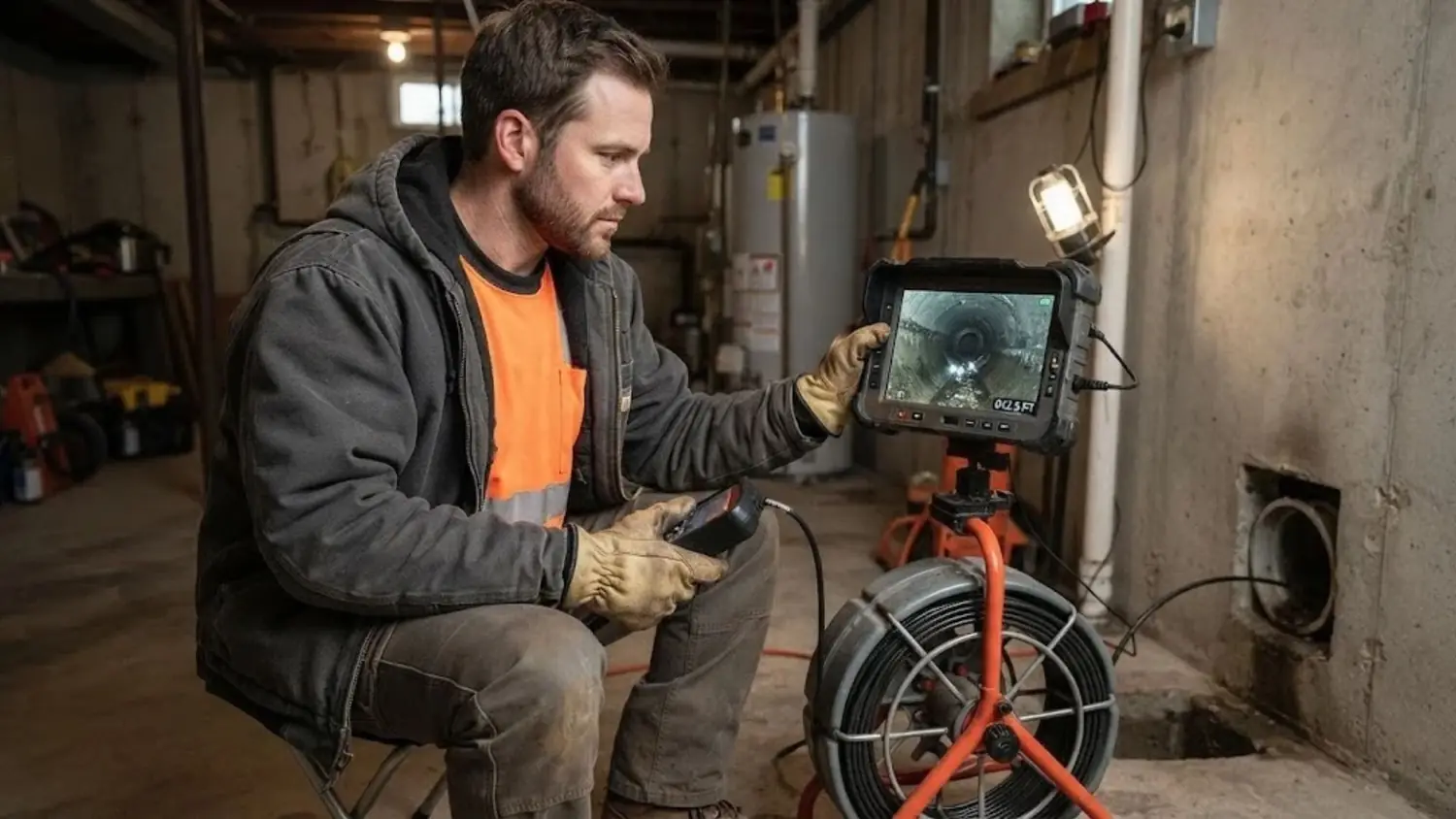
What a camera inspection shows
A waterproof camera head with lights travels from a cleanout through the line toward the street. A monitor shows the pipe wall as it goes. We see cracks, offset joints, root entry, belly sections where water pools, scale, grease, and sometimes objects that should not be there.
A locator transmitter in the camera head lets us find its position and depth from the surface. We mark the spot on the ground, so any repair starts at the right place. You can watch the monitor and ask questions as it happens.
When an inspection is worth it
A camera run costs much less than guessing wrong.
- Repeated clogs in the same line.
- Buying a house built decades ago.
- A sunken or wet patch in the lawn near the line.
- Gurgling toilets or a sewer odor with no clear cause.
- Before a hydro jetting or pipe lining job.
- After a root cut to see whether the pipe was damaged.
- Before pouring concrete or building over a buried line.
How the inspection works
The visit is short and non-invasive.
Find the access.
A cleanout in the yard, basement, or crawlspace lets the camera in. If none exists, we can go through a toilet.
Clear what blocks the view.
If grease or debris prevents a clear view, we flush or clean the line first.
Record the run.
The camera travels the line while the footage records. We note and mark each defect.
Review together.
We show you the video and explain what each defect means and what, if anything, needs doing.
What we find and what it means
Each finding points to a different next step.
| Camera finding. | What it means. | Next step. |
|---|---|---|
| Root intrusion at a joint. | Water and nutrients reach the roots through a gap. | Cut roots, then consider repair or lining. |
| Belly or low spot. | Soil has settled and water pools. | Spot replacement if it holds debris. |
| Offset or separated joint. | Pipe sections no longer align. | Repair the joint. |
| Heavy grease or scale. | The pipe is narrowed but intact. | Hydro jetting. |
| Collapsed section. | The pipe has failed. | Excavate and replace. |
Buying an older house in Carroll County
The City of Carrollton asks owners of structures built in 1989 or earlier to check their water service lines, and that cutoff suggests how much older housing stands in the area. Older houses frequently have older sewer lines too, and a pre-purchase camera run gives you facts to negotiate with.
Ask the seller for permission to access the cleanout. If the camera finds a failure, you can ask for repair, a price adjustment, or a credit. Without the video, the buyer takes on the unknown.
How to read the findings
A camera report is only useful if you can tell which defects matter. A hairline crack in a sound pipe is different from a joint that has separated by an inch. A small bellied section that holds a cup of water is different from one that holds a gallon.
We rank each finding by whether it will fail soon and whether it causes the symptoms you have. That lets you decide what to repair now, what to watch, and what to ignore. If you are buying a house, it lets you negotiate with accurate information.
Cleanouts and why they matter
A cleanout is a capped pipe that gives direct access to the sewer line. Houses built decades ago often have none, and houses that do may have one buried under soil or mulch. Without a cleanout, every clog and every camera run has to start at a toilet.
If we find your line has no cleanout, we can install one. It costs a small amount compared with the savings on future service calls, and it gives any plumber direct access to clear a blockage.
Code and permits for this work
Georgia's Department of Community Affairs publishes the state's amendments to the International Plumbing Code (IPC), the standard that plumbing work in Georgia is measured against, and the City of Carrollton issues plumbing permits through its permits office. A camera run is a look, not a repair, so no permit is needed, and the footage helps if a permit is needed afterward.
What changes the price of a camera inspection
Inspection is priced as a service call, not by the foot.
- Line length and access point.
- Whether the line has to be cleaned first.
- Whether a locating and marking service is included.
- Whether you want a copy of the footage.
- After-hours scheduling.
You see a clear price before work starts. If the camera finds a problem during a clog call, we tell you what it costs to go further before we continue.
Camera inspection questions
A typical residential line takes under an hour once the camera is in. Cleaning the line first adds time.
Yes. Ask us to save a copy for you when you book.
Yes. Call us with the address and we arrange it around the closing schedule, with the seller's permission to open the cleanout.
We can usually go in through a toilet. Pulling a toilet takes a little longer and we reset it afterward. We recommend adding a cleanout when we find none.
Not automatically. If a line has clogged repeatedly, we recommend one. See our drain cleaning page for the clog-clearing side.
Not sure if you need an inspection? Call and tell us the history of the line. Call (770) 214-4545